By MARTIN DeANGELIS Staff Writer, 609-272-7237
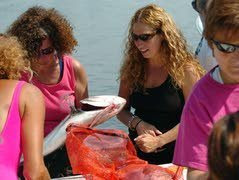
ATLANTIC CITY - The Ladies Invitational Bluefish Tournament is always a fun day for Danielle Brooks and her friends, so they really wanted to be in this year's edition of the tournament Saturday.
They like the cause it supports - it raises money to provide free mammograms and other breast cancer-related services to women who don't have health insurance. Plus they like to fish, and they like to compete with other women who fish.
The only trouble was, the only boat they could get their hands on this time was big, a 52-footer. And big boats have big fuel tanks, which means they also have big fuel bills - especially these days, with fuel prices jumping like a freshly hooked sailfish, pushing $5 per gallon at some area marinas.
So Brooks and her friends decided to send out e-mails asking their family members and friends for help paying the $3,000 worth of expenses it took to be in the tournament - much of that just on the fuel. And they got enough support to fish again this year, but the head of the tournament says high fuel prices definitely cost her cause this time around.
Last June, Kim Kirk says, there were 79 boats in the tournament, which ended up raising $70,000 for AtlantiCare's Mobile Mammography program. This year, the number was down to 68 - and that was after a big rush of entries the day before the lines hit the water. As of Thursday, she had just 39 boats registered, about half of last year's total.
"I would have liked last year's numbers, but considering the economy, it's better than it might have been," Kirk said Saturday, adding that she heard lots of talk around the tournament about fuel prices - including from some women who said the cost kept them out of the competition.
And local people associated with other good causes - even ones that don't seem as oil-dependent as boat-based fishing tournaments - say their organizations are also being burned by rising oil prices.
The American Cancer Society has a program called Road To Recovery, which involves volunteers picking up and driving cancer patients to doctors' visits and other treatments. And while most of the volunteers - many of them former patients themselves - are still willing to help, a few drivers have been forced to drop out, an executive in the local chapter says.
"The South Jersey region, from Burlington County to Cape May, is 3,000 square miles," said Sheila Williamson, a regional vice president. "Some of our patients are being treated in Philadelphia or other places out of state, and it's really a challenge to find (volunteers) willing to drive them to Philadelphia."
The Community FoodBank of New Jersey's Southern Branch hasn't lost any volunteers, because most of them live fairly close to its warehouse in Egg Harbor Township, Evelyn Benton says. But oil prices are having an "awful" effect on her organization, the executive director adds, because three commercial-size trucks are a key part of the operation.
"We have to pick up food and we have to deliver food: That's not an option for us," Benton says. "And we've been paying over $4 a gallon for diesel for months now."
The trucks average about 8 miles to the gallon, and she doesn't see any help coming down that road.
"They haven't come out with good (fuel-efficiency) technology for commercial trucks, and even if they did, it's way too expensive for us," Benton said. "Until those things become cheap, a charity is never going to have one."
But unless something changes, the food bank will keep collecting and delivering food to its largest customers, other charities, for a total of 23 cents per pound - 18 cents for the food itself and the other nickel for delivery. That's in spite of the fact that it actually costs 32 cents per pound for the food bank to do what it does, and the only change likely to come there is higher real costs.
"We increased our fuel budget this year by 15 percent, and we're already way over budget," she says, adding that the 23-cent cost figure is set by national rules. But even if the local food bank could raise its rates on its own, she doubts the customers could pay.
"Our charities are smaller than we are, so you sort of hate to pass along the costs to charities that can afford it less than we can," Benton says. "A lot of people are struggling, but people who are poor are in an even worse situation, and so are organizations that support the poor."
Gilda's Club South Jersey, based now in Somers Point, offers emotional support to people with cancer and their families. Sarah Griffith, the executive director there, says she's starting to see a drop-off in people showing up for some of its social activities.
"Not in our core programs, but I have noticed a little bit of a decline" in attendance, she says. "And we've started saying, 'Hmm, I wonder if that has something to do with gas prices? ... People are saying, 'Do I have to do this? No I don't - I don't have to drive.'"
But the only way to get in the Ladies Invitational Bluefish Tournament was by boat, and Kim Kirk is glad that women got onto 68 boats Saturday to support its good cause - despite the costs. But she understands how money would hurt her turnout.
"For people with bigger boats, you're talking $1,500 a day for fuel," she says. "That's a hard chunk of change to bite off at one time."
To e-mail Martin DeAngelis at The Press:


